
The Classroom Egg Hatching Professional Development session took place on January 22, 2026, hosted by the 2024 National Ag in the Classroom Outstanding Teacher Award winner, Carrie Allord. Participants learned how to secure fertilized eggs, what to do with the chicks once they hatch, equipment and supply recommendations, curriculum connections, and more!
Carrie Allord has over fifteen years of classroom hatching experience. She is a fourth-generation farmer whose family farm has a greenhouse and cattle. Through farm visits, spending time with Cinnamon, her class chicken, and watching classroom eggs hatch, Carrie’s students experience agriculture in unforgettable ways.
Preparation
Before bringing egg hatching into your classroom, you need to plan ahead. Determine where you are getting the fertilized eggs and what you will do with the chicks once they’ve grown. If you choose to send the chicks home with students, make sure to communicate with parents about how they need to prepare. Come up with a plan for if the eggs do not hatch or if a chick does not survive. You will also need to consider how you will manage the chicks’ waste and maintain a clean classroom.
Supplies
Fertilized Eggs
Sourcing fertilized eggs does not have to be a difficult task. Maybe a student has chickens and is willing to provide the classroom’s eggs. Reaching out to local farmers or people who can connect you with local farmers is always a great option. You can also order fertilized eggs online, but keep in mind that the hatch rate is typically lower for eggs that travel by mail. Carrie once bought fertilized eggs off Facebook Marketplace!
Incubator
An incubator is essential for egg hatching, as the device provides warmth and moisture to the developing eggs. Many incubators are available at a variety of price points. Carrie Allord has used many incubators and recommends the Brinsea Mini II Incubator. Incubators are often $120–$250, so Carrie recommends using grant money to purchase an incubator.
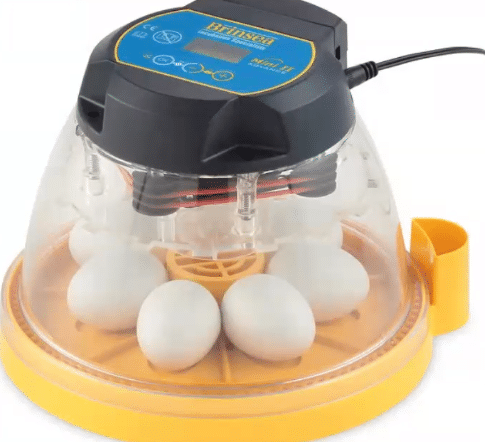
You must properly handle and care for the incubator for the best hatching results. This includes thoroughly cleaning the incubator between batches, plugging in the incubator and stabilizing the temperature a day before receiving the fertilized eggs, and keeping the incubator on a stable surface (a lesson once learned the hard way in Carrie’s classroom). Eggs in the incubator need moisture, and some incubators are able to maintain a moist environment automatically. Additionally, try to keep the incubator closed as much as possible, as opening the incubator releases moisture and changes the internal temperature. You must keep the incubator closed, especially in the last few days before hatching.
Brooder
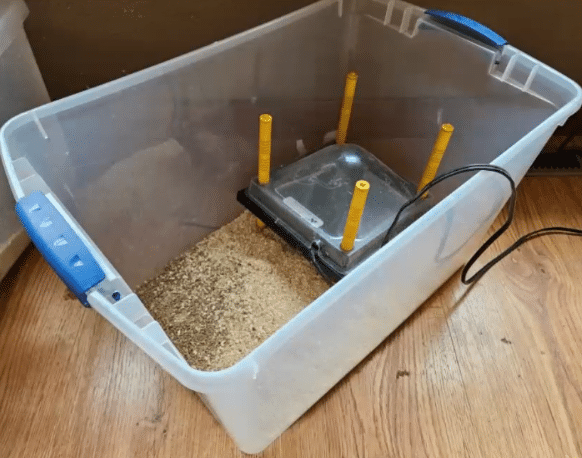
A brooder is where the chicks will go once they have hatched. A brooder, which is often just a plastic tote, needs a heat source to keep the chicks warm. Carrie recommends using a heat plate rather than a heat lamp and adjusting the height of the plate to the height of the chicks. The floor of the brooder should have paper and small shavings, which is basically the chicken version of cat litter. The chicks will also need food and water feeders in the brooder.
Caring for Chicks
Now for the exciting part: the egg hatching! Carrie made it clear that you must be patient and allow the chick to leave the egg on its own. Some chicks will never come out, but it is essential to never help a chick out of its egg. If the eggs hatch overnight, no worries! The chick will ingest the yolk when it first hatches and will need food and water within the next 24 hours. Carrie recommends that you show the chick that the water is there by dipping its beak into the water.
Keeping the classroom sanitary is essential. Carrie Allord’s class washes their hands after holding chicks, and they clean any surfaces that the chicks touch. They wear aprons or old shirts to protect their clothes, and they keep chicks off any carpet. Before the eggs hatch, come up with a plan for properly disposing of the chicks’ waste. Carrie Allord uses grant money to purchase litter that is frequently changed out, much like cat litter.
Curriculum
Integrating curriculum into your classroom egg hatching can be easy! Classroom egg hatching is the perfect context to teach students about the eggs, the growth of the chicks, and more.
- Chicken Math: Carrie Allord teaches addition to her kindergarten class through what she calls “chicken math.” Instead of telling the students that 2+3=5, Carrie tells her students that if you add 2 chicks with 3 other chicks, you will have 5 chicks!
- Books: Carrie recommends the books “Hatching Chicks in Room 6” by Caroline Arnold and “Where Do Chicks Come From?” by Amy E. Sklansky.
- Candling: Candling is when you shine a light onto the egg to see the inside. Carrie Allord recommends using clay to make a nest to stably prop up the egg, and she often uses her phone flashlight. Wait 3-5 days between candling though; opening the incubator too much could impact the hatching success.
- Lesson Plans: Minnesota Agriculture in the Classroom has tons of chicken related lesson plans available to you for free!
- Eggology (Grades K-2) & Eggology (Grades 3-5)
- Hatching Science with Classroom Chicks (Grades K-2) & Hatching Science with Classroom Chicks (Grades 3-5)
- Inside the Egg, Hatching Chicks (Grades K-2) & Inside the Egg, Hatching hicks (Grades 3-5)
- More chicken related lesson plans can be found in the Curriculum Matrix!
Resources
Lots of resources are available for you that are intended to support the success of egg hatching in your classroom! Many of the resources are even free of cost.
- Connect with local agriculture groups, Minnesota Farm Bureau, and Minnesota Agriculture in the Classroom for various egg hatching needs.
- Mike Kutzke from the Minnesota State Poultry Association joined the Professional Development session to share about the club’s willingness to provide support. The Minnesota State Poultry Association’s goal is to promote poultry, and many members are interested in supporting classroom egg hatching. The association is able to connect you with local places to source fertilized eggs, places to bring the chickens once they’re grown, and more! Connect with Mike through his email: mike.kutzke@gmail.com
- Apply for grants! Minnesota Agriculture in the Classroom offers two grants: the First Year Teacher Grant application is open all year long, and the application for Ag Literacy Grants is open at the beginning of a school year.
Utilize online resources! Online resources are available to learn about classroom egg hatching, including both the Hatching Science Center and the Hatching Science Curriculum resources from Minnesota Agriculture in the Classroom. Iowa State University Extension and Outreach also has great teacher guides (The Classroom Hatching Guide is available for free in the Curriculum Matrix).