

Why Ag in the Classroom?
Agriculture means survival. Over time, fewer and fewer people have close contact with farming and the total agricultural sector. They're not aware of their own and society's total dependence on agriculture. People must be agriculturally literate in order to make responsible decisions affecting this giant lifeline.
Teaching students to be agriculturally literate brings their learning to life. Helping students understand the farm-to-table connection is important in our consumer-driven society. That's what the student Minnesota AgMag Series is all about.
About Your AgMag
The AgMag is a great supplement to your social studies, science, or language arts curriculum. You'll get two issues per school year: October and March.
AgMag Theme: From the Land to You!
- The Cycles of Matter
- Compare and Contrast Different Burger Options
- Plants as Problem Solvers
- Caring for Her Pigs
Integration Ideas
Science/Math
- Discuss the Carbon Cycle graphic and information on pages 2-3, and have students create posters/powerpoints using other examples in the environment.
Social Studies
- Have students interview someone they know who works in agriculture. Invite someone with a career in agriculture to come speak to the class about how they got involved in agriculture.
English Language Arts
- Ask students to identify key ideas and details and build their vocabulary through the AgMag's informational text.
- Use agriculture as an inspiration for creative writing activities and group discussions. Ideas: Stories with characters who have agriculture careers; predictions for agriculture in 2050 (or future years); letters to students in other countries with descriptions about agriculture here and questions about agriculture there.
Glossary
Some words in your AgMag may be unfamiliar to your students. Many are defined in the articles. There is also a glossary on the AgMag website: https://mnagmag.org/glossary/ Words you might wish to pre-teach are:
AGRICULTURE: Growing plants and raising animals that people use for food, clothing and many other things every day. It's also harvesting those farm products and getting them to us so we can use them. Agriculture is the industry that grows, harvests, processes, and brings us food, fiber, fish, forests, sod, landscaping materials, and more. It uses soil, water, sun, and air to produce its products. The process starts on farms, orchards, gardens, and ranches with the growing and the harvesting of crops and livestock, then moves to processing plants before finally traveling as finished products to stores, farm markets, lumberyards, greenhouses, and more where consumers buy the products. Agriculture is connected in some way with almost everything we eat, wear, and use.
Quote from an Unknown Source: "Agriculture is not simply farming. It's the supermarket, the equipment factory, the trucking system, the overseas shipping industry, the scientist's laboratory, the houses we live in, and much more. It has an effect on the air we breathe, the ground we walk on, the water we drink, and the food we eat."
PRODUCER: a person, company, or country that makes, grows, or supplies goods or commodities for sale. Farmers are producers.
CONSUMER: a person who purchases goods and services for personal use.
MATTER: is another word for the stuff things are made of. Matter is a substance which has a certain mass and takes up a certain volume in space.
METHANE: colorless, odorless gas that occurs abundantly in nature and as a product of certain human activities.
DECOMPOSERS: an organism that breaks down dead plants and animals, as well as waste, for energy.
RUMINANT: A digestive system with four chambers of the stomach.
Minnesota Academic Standards Connection
| Subject | Standard Code | Benchmark |
| Science | 5L.4.1.2.1 | Evaluate the merit of a solution to a problem caused by changes in plant and animal populations as a result of environmental changes.* (P: 7, CC: 4, CI: LS4, ETS1) Emphasis is on evaluating solutions (based on evidence and design criteria and constraints), not developing new solutions. Examples of environmental changes may include land characteristics, water distribution, temperature, food availability, or the presence of other organisms. |
| 5L.3.1.1.3 | Create an electronic visualization of the movement of matter among plants, animals, decomposers, and the environment.** (P: 2, CC: 4, CI: LS2) Emphasis is on the idea that matter that is not food is changed by plants into matter that is food. Examples of systems through which matter cycles may include organisms, ecosystems, and the Earth. Examples of an electronic visualization may include a computer program, simulation, or animation. | |
| Geography | 5.3.16.1 | Describe how the choices people make have impacted a physical environment over time. |
| Health | 5.12.8 | Demonstrate effective decision-making skills to enhance health. |
AgMag Cover: From the Land to You!
Discussion Prompts
- What do you use in your daily life that comes from the land?
- What good can come from this animal on the cover?
- Make a web chart on your board with a beef animal in the center. Have students share ideas of what goods/products come from the animal. Encourage them to think outside the box.
Page 2-3: The Cycles of Matter
Discussion Prompts
- Why is it important to learn about the carbon cycle and how matter moves and changes?
- Have you ever wondered why we can’t eat the same grasses and foods that livestock eat?
- More information can found here https://www.iflscience.com/can-humans-eat-grass-66144
The Carbon Cycle
- Consider projecting the graphic and walking through the different phases of the carbon cycle with your students. Some students will understand it better when hearing it explained while also looking at a visual.
- This video is an additional resource for helping students understand the carbon cycle.
- Consider brainstorming with your class before turning the kids loose on this assignment. Ask for suggestions and ideas for animals/plants they could use to create a visual of the matter cycle. Students can work alone or in partners of 2-3 to create the visual. You could even extend this activity by having students create posters/presentations of the carbon cycle with their animal/plant of choice. Have them present the cycle to other groups in the class.
Page 4-5: Battle of the Burgers
Students compare beef, pork, turkey and plant-based burgers by determining the ingredients and nutritional differences between. Have students share why they would choose one kind of burger over another.
Discuss how Minnesota farmers are contributing to plant-based proteins and traditional proteins such as turkey, beef and pork.
- MN is the top producer of food grade soybeans in the U.S.
- 8% of fields in MN are planted with food grade soybeans according to the University of Minnesota Extension.
Have students use the calorie counter to compare and contrast other forms of protein in their diet that can be made from different ingredients, like almond milk vs. cow’s milk.
Show the video, Heme - The Magic Ingredient in the Impossible BurgerTM for students to learn more about one ingredient in the Impossible Burger that makes the plant-based burger more closely resemble a beef burger.
Page 6-7: Plants as Problem Solvers
Pre-reading Questions
- What is the difference between an annual and perennial?
- The key difference between annual and perennial plants lies in their lifespan: annuals complete their life cycle (seed to seed) within one growing season and die, while perennials live for multiple years, returning from their roots or base each spring.
- Why would farmers want to protect their soil?
- Decrease erosion from wind, rain and runoff. The amount of top soil farmers have on their field is limited. Once it’s gone you can’t make more.
Post-Read Discussion Questions
- Why was the Kernza grain a good solution for protecting the soil?
- The deep roots of Kernza help hold soil in place. The roots also make pathways throughout the soil that always water to go deeper into the ground. Kernza’s roots help to hold carbon in the soil. As a perennial Kernza makes good ground cover which keeps the soil in place during wind and heavy rains.
Activity Answers
- Grapes: perennial
- Watermelon: annual
- Asparagus: perennial
- Apple trees: perennial
- Potatoes: annual
- Pumpkins: perennial
Page 8: Caring for her pigs
Encourage students to read over the examples of how Lisa cares for her pigs on this page.
Discussion: Do students have pets or care for any animals of their own? How do they care for their animals like Lisa cares for her pigs?
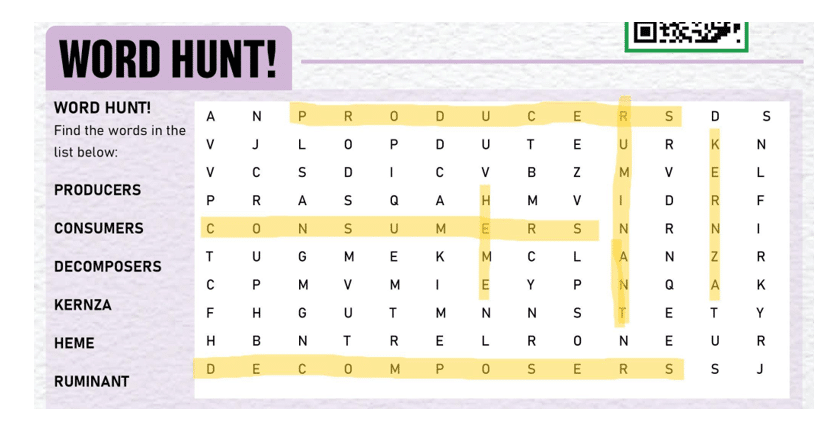
AgMag 5 Spring Quiz
- Which of the following would be a consumer in the matter cycle?
A. Beef Cattle
B. Alfalfa
C. Fungi
D. Bacteria - What is a popular feed for cattle?
A. Alfalfa
B. Kernza
C. A2 milk
D. Fungi - Which type of burger uses heme to mimic beef qualities in a burger?
A. Veggie
B. Impossible
C. Turkey
D. Pork - What makes the Kernza plant able to improve natural resource conservation?
A. Kernza is drought-resistance (needs less water).
B. Kernza is an annual so it must be re-planted each year.
C. Kernza has a deep root system that can improve soil health.
D. Kernza can be used as an ingredient in crackers, cookies and pasta. - Which of the following is an example of a cover crop?
A. Corn
B. Winter Camelina
C. Soybeans