

Why Ag in the Classroom?
Agriculture means survival. Over time, fewer and fewer people have close contact with farming and the total agricultural sector. They're not aware of their own and society's total dependence on agriculture. People must be agriculturally literate to make responsible decisions affecting this giant lifeline.
Using authentic agricultural examples as a context for core curricular concepts brings learning to life! Helping students understand the farm-to-table connection is important in our consumer-driven society. That's what the student Minnesota AgMag Series is all about.
About Your AgMag
The AgMag is a great supplement to your social studies, science, or language arts curriculum. The AgMag has particular appeal to the study of Minnesota history and geography. You'll get two issues per school year: October (Fall) and March (Spring).
AgMag Theme: Agriculture: Every Day, Every Way!
- Weather
- Minnesota Growing Seasons
- Winter Growing
- Caring for Forests
- Cool Tools from Nature
- Integration Ideas
Science
- Using information from page 2-4 focused on Weather, Minnesota Growing Seasons and Winter Growing, you could challenge your students to develop a plan for growing vegetables. Steps could involve determining the correct growing season for your area, which vegetable(s) you’d like to grow, and how long it will take for the vegetable to be ready to harvest. You can make this activity as involved as you’d like by having students choose the seeds, plant them, water them, and measure and observe the plants' growth.
Math
- The Seed Packet activity is a great way for students to work on addition and subtraction. Bring in seed packets that state how many days the seeds need to germinate and how many days until harvest. Students can practice their addition skills by determining when these dates will occur, according to the seed packet.
English Language Arts
- Use the AgMag to help students practice comprehension and reading informational texts.
Glossary
Some words in your AgMag may be unfamiliar to your students. Many are defined in the articles. There is also a glossary on the AgMag website: https://mnagmag.org/ag-terms-glossary/. Words you might wish to pre-teach are:
AGRICULTURE: Growing plants and raising animals that people use for food, clothing and many other things every day. It's also harvesting those farm products and getting them to us so we can use them. Agriculture is the industry that grows, harvests, processes, and brings us food, fiber, fish, forests, sod, landscaping materials, and more. It uses soil, water, sun, and air to produce its products. The process starts on farms, orchards, gardens, and ranches with the growing and harvesting of crops and livestock, then moves to processing plants before finally traveling as finished products to stores, farm markets, lumberyards, greenhouses, and more, where consumers buy the products. Agriculture is connected in some way with almost everything we eat, wear, and use.
Quote from an Unknown Source: "Agriculture is not simply farming. It's the supermarket, the equipment factory, the trucking system, the overseas shipping industry, the scientist's laboratory, the houses we live in, and much more. It affects the air we breathe, the ground we walk on, the water we drink, and the food we eat.
Growing Season
The season of the year in which rainfall and temperature allow the crop to grow.
Peak Season
This season occurs when the crop is ready to harvest and we can use it or eat it when it is fresh and most delicious.
Ricer
A person who harvests the grains from the wild rice stalks.
Minnesota Academic Standards Connection
| Subject | Standard Code | Benchmark |
| Science | 2P.4.2.2.1 | Obtain information and communicate how Minnesota American Indian Tribes and communities and other cultures apply knowledge of the natural world in determining which materials have the properties that are best suited for an intended purpose. |
| Science | 2E.2.1.1.1 | Represent data to describe typical weather conditions expected during a particular season. (P: 4, CC: 1, CI: ESS2) Examples of data may include temperature, precipitation, and wind direction. Data displays can include pictographs and bar graphs. |
| Science | 2E.2.1.1.2 | Analyze data from tests of objects designed to reduce the impacts of weather-related hazards and compare the strengths and weaknesses of how each performs.* (P: 4, CC: 2, CI: ESS3, ETS1) Emphasis is on data from tests of student-designed objects. Examples of design solutions to weather-related hazards may include barriers to prevent flooding or snow drifting, structures for sun shading, materials for clothing, and orientation of bus shelters. |
| Social Studies | 2.3.16.1 | Describe ways that the local environment influences people and their actions and how human actions impact the local environment, including air, water, land and wildlife. |
| English Language Arts | 2.2.1.3.1 | Choose and read texts that address the purpose (e.g., personal interest, enjoyment, academic tasks), representing perspectives and identities of historical and contemporary Dakota and Anishinaabe people. |
| English Language Arts | 2.2.1.4.4 | Describe the connection between a series of events, concepts, or steps in a procedure, in informational text.* |
AgMag Cover: Agriculture: Every Day, Every Way!
Discussion Prompts
- What is agriculture?
- What are you wearing right now that came from agriculture?
- What did you eat today that came from agriculture?
Connecting Things to Agriculture
- Your students may need a little guidance in connecting the everyday items they use to a raw agricultural product. Draw a diagram on the board that connects an item to agriculture.
- Ex: Cereal → main ingredient is grain → grown in a wheat field
- Ex: Pencil → cut and assembled in a factory → made from wood → wood cut from a forest
Define
- Because agriculture may be new to some of your students, make sure to go over the definition of agriculture.
- Agriculture: Agriculture is making things that grow on farms, like plants and animals, into things that we use.
Page 2: Why Weather Matters to Growers
Discussion Prompts
- Do any of you know a farmer? Did you know there are many farmers in Minnesota? They play a really important role in our state!
- Consider reading the bold first paragraph together as a class. You may need to answer questions or check to make sure students have comprehended the main idea on this page.
If you’d like to focus on “compare and contrast” skills on this page, consider having students get into pairs and read about farmers Laura and Rachel together. Have them create a Venn Diagram chart in which they can compare the similarities and differences between Laura's and Rachel’s farming practices.
Temperatures During Minnesota’s Seasons:
Answers:
1. 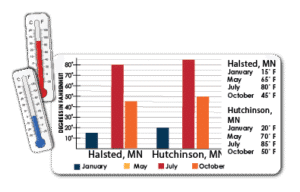
2. Hutchinson, MN
2A. Laura would be able to plant sooner because of the warmer climate where she farms
3. Rachel should harvest her crop first.
Page 3: Minnesota Growing Seasons
Discussion Prompt
- What plants have you seen growing in Minnesota?
- Make a list on the board as you brainstorm as a class. Some students may not have very much background knowledge on this, so try to help them come up with as many examples as possible.
Peak Season
- Help students by explaining what peak season is (when the crop is ready to be harvested). Explain that the dark orange is when the peak season occurs.
- Answers will vary depending on what time of the year you are reading this chart. If you are doing this in January, February, March, or April, the answer will be that no plants are in peak season because it is winter and so plants aren’t able to grow outdoors. However, we can learn on the next page about winter growing and how to extend the growing season of a plant.
Examples of Plants we CAN grow (this list is not comprehensive):
- Anything grown in a vegetable garden (tomatoes, cabbage, spinach, lettuce, carrots, etc.)
- Raspberries
- Strawberries
- Apples
- Pears
- Grains – in addition to wheat, Minnesota farmers grow oats, rye, barley, and wild rice
- Corn – both sweet corn for humans to eat and field corn that is fed to animals
Examples of plants we CAN’T grow (this list is not comprehensive):
- This list includes plants that need warmer temperatures and heavier rainfall than what naturally occurs in Minnesota.
- Pineapple
- Mangoes
- Plantains
- Kiwi
- Pecans
- Almonds
Page 4: Winter Growing
Discussion Prompts
- What would we have to do in order to grow plants outside in the winter?
- What conditions does a seed need in order to be able to grow?
- Answer: (sunlight, right temperature, water)
Seed Packet Math
If you planted on March 1st, the carrots would be ready to harvest 60 days later on May 1st.
If you planted on May 7th, the carrots would be ready to harvest 60 days later on July 7th.
Consider bringing in other seed packets and doing the math to know when the plants would be ready to harvest. You could also find pictures of seed packets online.
Page 5: Caring for Forests
Discussion Prompts
- What kind of weather do trees need to grow well?
- Northern Minnesota is cool, sunny, and gets lots of rain. That’s why trees like red pine, sugar maple, and aspen grow well there.
- Ask students: What kind of weather do we have here? Do you think the same trees would grow well in a desert or on a tropical island? Why or why not?
- How has logging changed over time?
- Then: In the 1990s, loggers used to pile leftover limbs in big stacks.
- Now: Today, the best practice is to scatter those limbs across the forest floor. This helps the soil stay healthy and supports new tree growth.
- Ask students: Why do you think people changed the way they do this job?
- How do people take care of forests?
- Matt and his team are loggers. Before they cut trees, they meet with Corey the forester to make a plan. This plan protects animals, soil, air, and water. They also leave leftover tree parts to help the forest grow back.
- Ask students: Why do you think it’s important to follow rules in the forest?
- What happens to leftover tree limbs?
- In the past, they were piled up and left. Now, teams spread them out to return nutrients to the soil and help new trees grow.
- Ask students: How does this help keep the forest healthy?
Extension Idea
Show students a weather chart for northern Minnesota and compare it to a desert or tropical region. Discuss how climate affects what grows in each place.
Optional Resource:
Use an online weather or climate database like weather.com or National Geographic Kids to look up typical weather for:
- Bemidji, MN
- Phoenix, AZ
- Honolulu, HI
Ask Students:
Which place is best for growing trees like red pine? Why?
Page 6: Cool Tools from Nature
Discussion Prompts
-
What tools do you use at home or school?
- Ask students: What tool helps you write, eat, or build something?
-
How do tools make life easier?
- Ask students: Imagine trying to build a snowman with no gloves or shovel. What would you do?
-
What would you do if your tool didn’t exist?
- Just like Thomas uses tools made from nature to gather wild rice, we can be creative, too!
- Ask students: If you needed to write a message but didn’t have a pencil, what could you use instead?
Creative Activity: Nature Tool Challenge
Scenario:
You need to write something, but pens, pencils, markers, and crayons haven’t been invented yet.
Try this with students:
Go on a short nature walk around the school. Ask students to collect or point out natural items they could try using as a writing tool.
Possible discoveries:
- Charcoal or ash to make marks
- Sticks or feathers to dip in water or mud
- Flower petals to press or smear color
- Rocks to scratch onto surfaces
Ask students: What would your tool look like? What could you use it for?
Extension Idea: Problem-Solving with Tools
Have students think of a tool that would help them with a real-life problem at home or school.
Discussion Prompts
- What problem do you want to solve?
- What would your tool do?
- What would you make it out of?
Let students sketch their tool and share how it works!
Activity Key: Can You Find These Images?
- Soil from 2nd Graders Pot: Page 4
- Red Leaves: Page 5
- Cauliflower: Page 2
- Trembling Aspen: Page 5